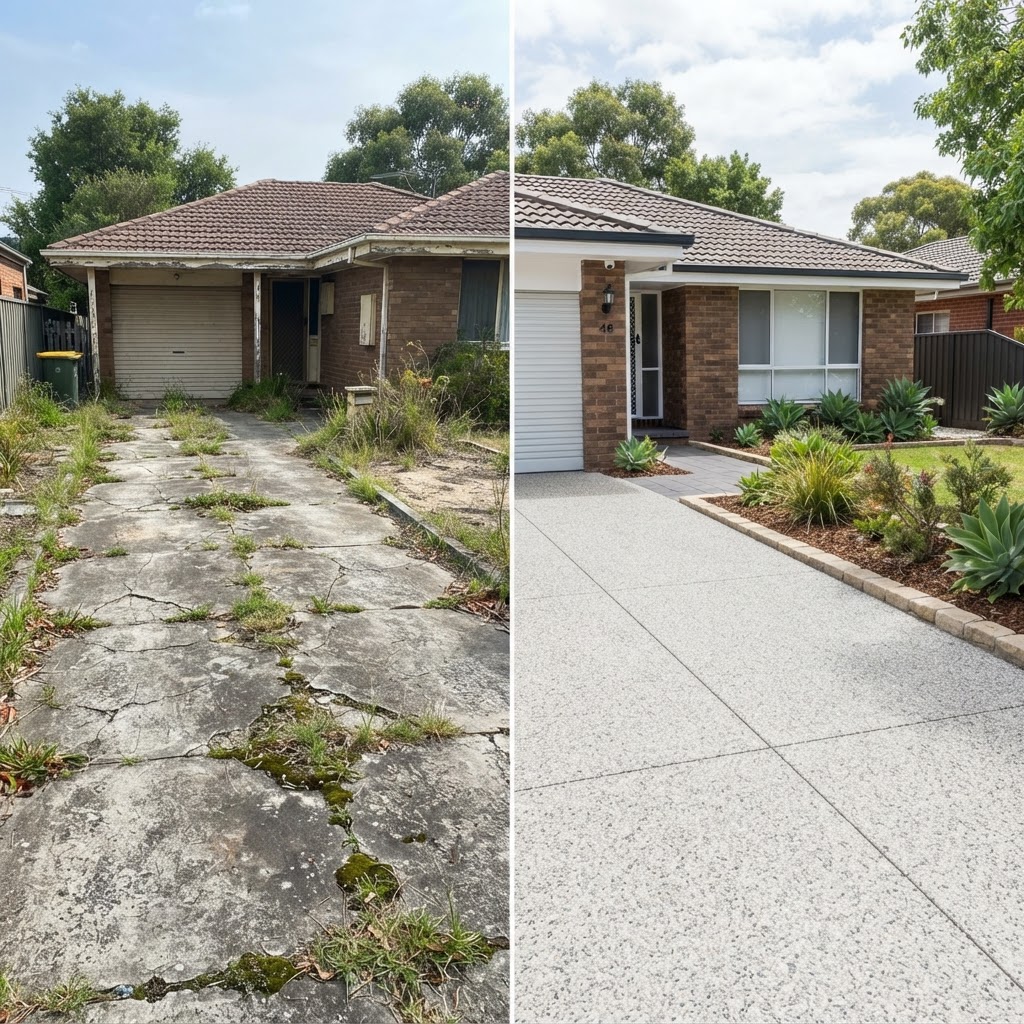
Most driveways that get replaced didn't fail overnight — they've been telling you for years. The question is which signs mean replace and which ones mean leave it alone. Here are the seven that say replace, and the three that don't.
The 7 signs that say replace
- Mapped / network cracking — Cracks that run in every direction, joining up like a web. What it's telling you: the slab has lost structural integrity across the whole surface, not just one spot. The base has moved under the entire driveway. Patching one crack doesn't help — the rest will follow.
- Vertical displacement at joints — One side of a crack or joint is higher than the other — a lip you can feel driving over. What it's telling you: the slab is moving in pieces, not as one. The base under one section has failed. It will only get worse, and it's a trip and a tyre hazard.
- Sinking at the garage or crossover — The slab has dropped where it meets the garage floor or the street, leaving a step. What it's telling you: the ground at the edge has settled or eroded, and the slab has followed. Mud-jacking can lift it, but if the cause is ongoing settlement, it'll sink again.
- Pooling water — Water sits on the driveway instead of running to the street. What it's telling you: the falls have moved (the slab has heaved or sunk) and water is now collecting where it shouldn't. Pooling water into a crack is the fastest way to widen it and undermine the base.
- Crumbling edges — The edges of the slab are breaking away, exposing the aggregate or the mesh. What it's telling you: the concrete at the edge was too thin or too weak, and water and frost are breaking it down. The edge is where a slab is weakest, and once it goes, the crack runs in.
- Widespread spalling — The surface is flaking and peeling away in patches, leaving the aggregate exposed across the slab. What it's telling you: the surface layer has failed — usually from freeze-thaw, de-icing salts, or a poor cure. It's not just cosmetic; the surface is gone.
- No steel visible at breaks — Where the slab has cracked through, you can see there's no mesh in it (or the mesh is on the bottom, doing nothing). What it's telling you: the driveway was poured without reinforcement or with it placed wrong. It was never going to hold. Every crack will widen and new ones will come.
The 3 signs that say leave it
- Hairline shrinkage cracks — Thin, surface-only cracks that don't run edge to edge. These are normal — concrete shrinks as it cures and hairlines are the result. They don't affect the structure. Leave them or fill them with a flexible sealant to keep water out.
- A single isolated crack — One crack, not joined to others, with no vertical displacement. If the slab is otherwise sound and the crack isn't moving, a crack repair (routing and sealing) is the right fix. It's a fraction of the cost of a replacement and it stops water getting in.
- Cosmetic stains — Oil, tyre, or leaf stains on an otherwise sound slab. These are surface-only and don't mean the driveway is failing. A clean and a reseal (or a resurface if you want a new look) fixes it without a replacement.
If your driveway has two or more of the seven signs, repairing it is money you'll spend again — the replacement is the better option. If it has none of the seven, or only one of the 'leave it' three, leave it alone and maintain it.
If you're not sure which category your driveway is in, the quickest way to find out is to have us come and look. We'll tell you honestly whether it's a repair or a replacement — we turn down replacement work when a repair will do, because an honest answer is how you get the next job.