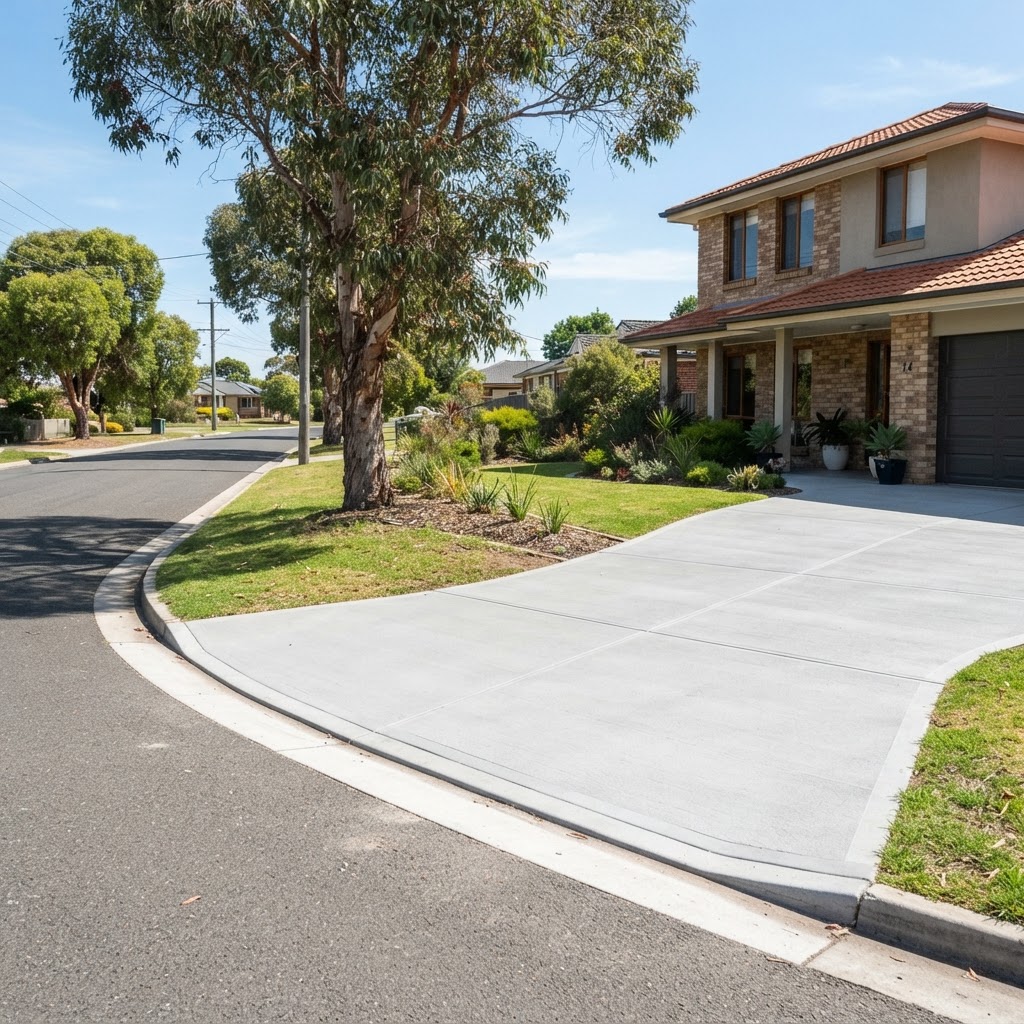
A concrete driveway in Melbourne should last 25 to 40 years. That's not a marketing number — it's what a properly built driveway does on reactive clay when the base, the reinforcement, the joints and the drainage are all done right. The driveways that fail at five or ten years aren't unlucky; they're missing one or more of those things. Here's what decides whether your driveway makes it to forty or cracks at five.
The five factors that decide a driveway's lifespan
- Base prep on clay — The reactive clay under most of Melbourne's southeast swells and shrinks seasonally. A driveway poured straight onto clay or onto a thin, uncompacted base will move with it and crack. A driveway with 100–150mm of compacted crushed rock under it moves with the base, not the clay, and that's the difference between a twenty-year driveway and a five-year one.
- Reinforcement chaired — F62 mesh sitting on the ground does nothing; it has to be on bar chairs so it sits in the middle of the slab where it does its job. Mesh on the bottom is the same as no mesh. We chair every sheet.
- Joint placement — Concrete cracks where it wants to. Control joints tell it where to crack — straight lines inside the joints, not across the slab. The spacing and the depth of the joints matter; a joint that's too shallow or too far apart doesn't control the crack.
- Drainage — Water is the thing that kills driveways faster than anything else. A driveway that sheds water to the street lasts decades; one that holds it against the house or in a low spot fails in years. The falls are part of the build, not an afterthought.
- Sealing — A sealer protects the surface from oil, staining and water ingress. Exposed aggregate needs resealing every 2–4 years; plain concrete is optional but recommended. A sealed driveway looks better and wears slower.
The failure timeline of a cheap driveway
A driveway poured thin with no base, no chaired mesh, and no proper joints doesn't fail on day one — it looks identical to a good driveway for the first year or two. That's why cheap quotes win. Here's what happens next.
- Year 2 — Hairline cracks appear. The concrete has moved with the clay through two seasonal cycles and the mesh (if any) wasn't chaired, so it hasn't held. The cracks are thin and easy to ignore.
- Year 5 — Edge cracking and the first structural cracks. The base has moved under the slab, the control joints (if placed) haven't held, and cracks are now running across the slab, not just inside the joints. Water gets in and the cracks widen through winter.
- Year 10 — Replacement. The slab is cracked through, sunken at the garage or the crossover, holding water, and beyond repair. The money saved on the original quote now buys a full rip-out and replacement — the most expensive way to buy a driveway.
The cheap driveway costs more than the good one. You pay for it once at year ten, and you pay for it again when you replace it. The driveway poured properly costs more on day one and nothing for thirty years.
Maintenance that adds decades
- Reseal exposed aggregate every 2–4 years (when water stops beading on the surface).
- Keep the driveway clean — wash off oil and fuel drips; they degrade the sealer and the surface.
- Don't let water pool against the edges or the garage — if you see pooling, call us to look at the falls before it becomes a crack.
- Don't drive on it for 7 days after a pour, and keep heavy vehicles off for 28 days. A new driveway that's loaded too early never reaches full strength.
- Fill any hairline cracks that do appear with a flexible sealant — it stops water getting in and widening them.
A driveway that's built right and maintained even modestly will outlast most of the other improvements you make to a property. The ones that fail early were never going to make it — the lifespan was decided on pour day, not by luck.