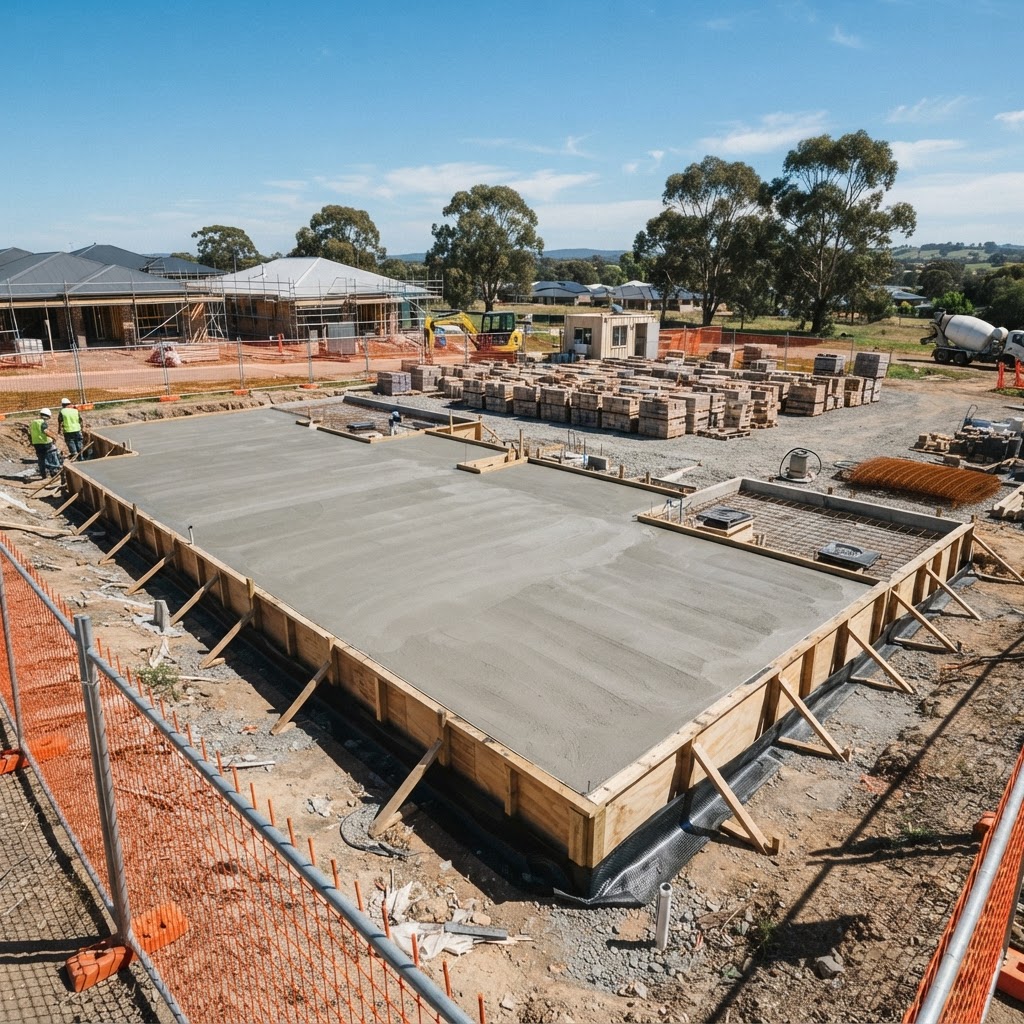
Most of Greater Dandenong sits on reactive clay — the soil that swells when it's wet and shrinks when it's dry, season after season. It's the reason a slab design that's fine on a stable sandy block in another part of Melbourne will crack on a block in Dandenong North or Keysborough. If you're building here, the slab has to be designed for the ground — and the ground has to be tested before the slab is designed. That's not an upsell; it's the difference between a slab that moves with the seasons and one that cracks through them.
What reactive clay actually does
Reactive clay changes volume with its moisture content. In winter, when the clay is wet, it swells and pushes upward. In summer, when it dries, it shrinks and pulls away. The movement is measured in millimetres, but it's enough to crack a slab that isn't designed for it. The site classification system — A, S, M, H1, H2, E — rates how reactive the soil is, from stable (A) to extremely reactive (E). Most of the new estates in Keysborough and Lyndhurst classify as H-class sites, and some of the older blocks in Dandenong North and Springvale are H1 or H2.
Why it eats slabs
A slab fails on reactive clay because of differential movement — the clay doesn't move evenly. The edge of the slab near the garden might heave while the centre stays put, or one corner might drop as a tree root draws moisture out of the clay under it. A generic slab — a flat pour with no edge beams and no designed reinforcement — can't accommodate that uneven movement, and it cracks across the slab where the movement is greatest. A slab designed for the site class puts the stiffness where the movement is — deeper edge beams, stronger mesh, and a profile that bridges the differential movement instead of cracking with it.
Waffle raft vs conventional on clay
- Waffle raft — The slab sits on a grid of polystyrene pods with concrete ribs between them, creating a stiff grid that bridges the ground. It's the standard for most H-class residential sites because it's efficient, fast to pour, and the grid structure handles the differential movement well. It needs good drainage underneath — water sitting under a waffle raft is a problem.
- Conventional (stiffened raft / waffle-pod alternative) — A slab with deep edge beams and internal beams poured into the ground, with mesh across the top. It's used where the site needs deeper engagement with the ground — on highly reactive sites, on cut-and-fill blocks, or where the engineer specifies it. It costs more but it engages the ground more deeply.
The engineer chooses between them based on the soil test, the site class, the block's fall, and the loads. We pour whichever the engineer specifies — we don't substitute one for the other to save cost. The wrong slab type on the right site class is how you get a cracked slab.
The soil test is the best investment of any build
A soil test is a small upfront investment and it tells the engineer exactly what the ground will do. A slab designed without a soil test is a guess. On a H-class block, a guessed slab is a cracked slab — and replacing a house slab is a major expense. The soil test is the cheapest insurance in the build.
What changes on your quote
- Beam depth — H-class sites need deeper edge beams and internal beams. More concrete, more excavation — and it's the reason two honest quotes on the same street can differ.
- Mesh — Higher-reactivity sites need heavier mesh or more of it. The mesh spec is on the engineer's drawing and it's not negotiable.
- Edge profiles — The shape of the slab edge (the beam) changes with the site class. A deeper beam means more formwork and more concrete.
- Slab type — A conventional slab takes more work than a waffle raft. The engineer decides which one your site needs.
When you compare slab quotes, compare them against the engineer's drawing — not against each other's square-metre rates. A cheaper slab quote on an H-class site is almost always a slab that's been shaved to win the job, and the shaving is in the beams, the mesh, and the edge profiles that the site class demands. We quote the drawing, every time.